
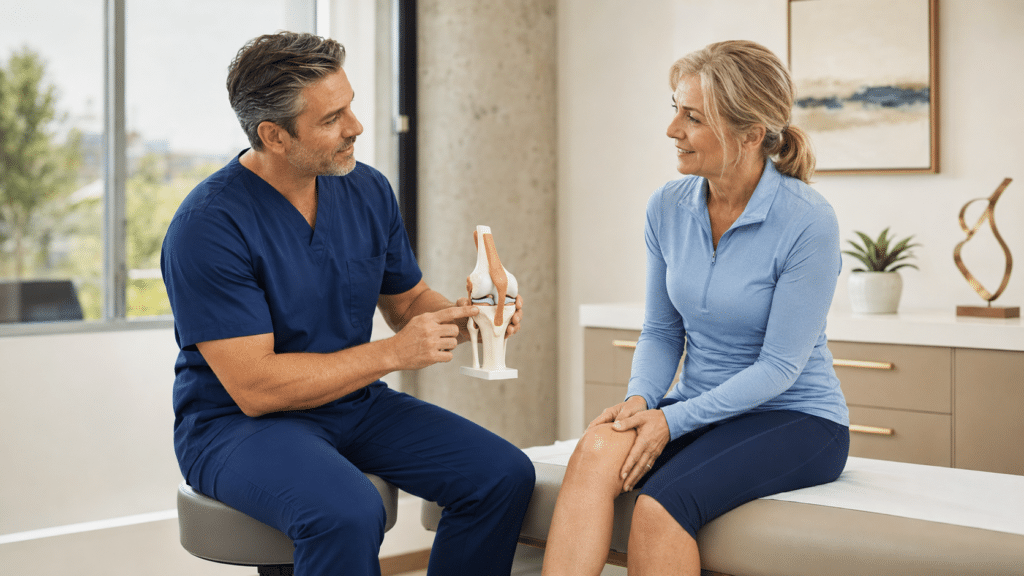
Knee arthritis can gradually turn simple activities into daily challenges. Walking upstairs, getting out of a chair, exercising, or spending time on your feet may become increasingly uncomfortable.
When knee pain begins interfering with normal life, many patients assume joint replacement is their only remaining option. Surgery can be an effective and appropriate treatment for advanced knee arthritis, but it is not always the first or only step.
For certain patients, PRP for knee arthritis may help reduce pain, improve function, and make it easier to remain active without immediately moving forward with surgery. However, PRP cannot rebuild a severely damaged joint, and it cannot guarantee that knee replacement will never be necessary.
The real question is whether PRP can provide enough meaningful improvement to help you function better and potentially delay surgery. The answer depends on the severity of the arthritis, your overall health, your goals, and how your knee responds to treatment.
What Is Knee Arthritis?
Knee arthritis occurs when the joint’s cartilage and surrounding structures change over time. Cartilage normally creates a smooth surface that helps the bones move with minimal friction. As cartilage becomes thinner or damaged, the knee may become painful, stiff, swollen, or harder to move.
Osteoarthritis is the most common form of knee arthritis. It is often called “wear-and-tear” arthritis, although the condition is more complicated than simple wear alone. Age, previous injuries, genetics, body weight, activity history, joint alignment, and muscle strength can all influence how arthritis develops and progresses.
Common symptoms include:
- Pain during walking, stairs, exercise, or prolonged standing
- Stiffness after sitting or resting
- Swelling around the knee
- Reduced range of motion
- Grinding, clicking, or catching sensations
- Difficulty getting up from a chair
- A feeling that the knee is weak or unstable
- Reduced ability to participate in normal activities
The severity of symptoms does not always match what appears on an X-ray. Some patients have significant imaging changes with manageable symptoms, while others experience substantial pain with less advanced findings.
What Is PRP?
Platelet-rich plasma, or PRP, is prepared from a sample of the patient’s own blood.
The blood is placed into a centrifuge, which separates and concentrates the platelets. Platelets contain growth factors and signaling proteins involved in the body’s natural healing response. The platelet-rich portion is then injected into the affected knee joint.
The goal of PRP knee injections is to influence the joint environment in a way that may reduce pain, improve function, and support the body’s natural repair processes.
PRP is not a synthetic medication, steroid, or surgical implant. Because it is prepared from your own blood, the risk of an allergic reaction is low.
How Does PRP for Knee Arthritis Work?
Knee arthritis involves more than cartilage loss. It can also affect the joint lining, underlying bone, surrounding muscles, and chemical environment within the knee.
PRP contains concentrated platelets that release growth factors and other proteins after injection. These substances may help regulate inflammation and support biological processes involved in tissue repair.
For patients with knee arthritis, PRP may potentially:
- Reduce pain
- Improve knee function
- Make walking and exercise more comfortable
- Reduce stiffness
- Support a healthier joint environment
- Improve quality of life
- Delay the need for more invasive treatment in some cases
PRP should not be described as a cure for arthritis. It also should not be expected to completely regrow missing cartilage or restore an advanced arthritic knee to its original condition.
The primary objective is meaningful symptom relief and improved function.
Is PRP Effective for Knee Arthritis?
Research suggests that PRP may improve pain and function for some patients with knee osteoarthritis, especially those with mild to moderate disease.
A recent meta-analysis of randomized controlled trials found that PRP produced clinically meaningful improvements in pain and function compared with placebo. The researchers also found that treatment outcomes appeared to be influenced by platelet concentration.
However, not every study has reached the same conclusion, and PRP protocols are not standardized. Results can vary depending on:
- How the PRP is prepared
- The concentration of platelets
- The number and timing of injections
- The severity of arthritis
- The patient’s age and general health
- Joint alignment
- Body weight
- Activity level
- The presence of other knee conditions
- Rehabilitation and lifestyle factors
The available evidence is encouraging, but PRP does not work equally well for everyone. It should be recommended following an individualized medical evaluation rather than treated as a universal solution for knee pain.
Can PRP Help You Avoid Knee Surgery?
PRP may help some patients delay surgery, but it cannot guarantee that surgery will never be needed.
If PRP reduces pain and improves knee function enough to support daily activities, exercise, work, and recreation, a patient may decide that surgery is not currently necessary. That improvement may last for months or longer, depending on the individual and the severity of the arthritis.
This can be valuable for someone who:
- Is not ready for joint replacement
- Wants to remain active using non-surgical care
- Has mild or moderate knee arthritis
- Cannot take certain pain medications
- Wants to delay surgery for personal or medical reasons
- Has not received enough relief from other conservative treatments
PRP is less likely to eliminate the need for surgery when arthritis is advanced, the joint is severely narrowed, there is substantial deformity, or pain and disability remain severe despite appropriate non-surgical care.
The most accurate way to describe PRP is as a potential tool for managing symptoms and improving function—not as a guaranteed replacement for knee surgery.
Who May Be a Good Candidate for PRP Knee Injections?
A patient may be a good candidate for PRP if they have:
- Mild to moderate knee osteoarthritis
- Persistent pain despite conservative treatment
- Symptoms that limit exercise or daily activity
- A desire to explore treatment without surgery
- Realistic expectations about the potential results
- No medical condition that would make PRP inappropriate
PRP may be particularly appealing to active adults who want to remain mobile and continue participating in work, exercise, or recreational activities.
A sports medicine assessment can help determine whether your symptoms are primarily caused by arthritis or whether another condition is contributing to the pain.
When Might PRP Not Be the Right Treatment?
PRP may not be appropriate when:
- Arthritis is extremely advanced
- The knee has significant deformity or instability
- Pain is caused by a fracture, infection, or another urgent condition
- The patient has certain platelet, blood, or bleeding disorders
- The patient is taking medications that interfere with treatment
- Another knee injury requires a different approach
- The patient expects PRP to completely reverse arthritis
- Surgery is clearly the most appropriate treatment
Not every case of knee pain is caused by arthritis. Meniscus injuries, ligament problems, tendon conditions, referred pain, gout, and other conditions can produce similar symptoms.
That is why a medical diagnosis should come before an injection.
What Happens During a PRP Knee Injection?
The process generally begins with a consultation and knee evaluation. Your physician reviews your symptoms, medical history, prior treatment, activity level, and available imaging.
If PRP is appropriate, treatment typically includes:
- A small amount of blood is drawn from your arm.
- The blood is processed in a centrifuge.
- Platelets are concentrated into the PRP preparation.
- The knee is cleaned and prepared.
- The PRP is injected into the targeted area.
- You receive instructions for activity and recovery.
The complete visit takes longer than the injection itself because time is needed to prepare the PRP.
You can learn more about the treatment process on Thrive Medicine’s PRP sports injections page.
What Is Recovery Like After PRP Knee Injections?
Temporary soreness, stiffness, or swelling may occur after a PRP injection. This reaction can last for several days and does not necessarily mean the treatment was unsuccessful.
Patients may be advised to temporarily limit strenuous exercise or high-impact activity. Walking and normal daily movement may be allowed based on comfort and the physician’s instructions.
Unlike treatments designed to provide immediate pain relief, PRP generally works gradually. Some patients begin noticing improvement within several weeks, while others may require more time.
Recovery recommendations may include:
- Temporary modification of strenuous activity
- Gradual return to exercise
- Strengthening the muscles around the knee
- Improving hip and lower-body mechanics
- Low-impact cardiovascular activity
- Weight management when appropriate
- Following individualized post-injection instructions
PRP often works best as part of a broader knee-management plan rather than as a standalone procedure.
How Long Do PRP Knee Injections Last?
The duration of relief varies.
Some patients may experience improvement for several months, while others report benefits lasting a year or longer. The response depends on the severity of arthritis, activity level, health factors, and the specific PRP protocol.
PRP does not permanently stop the natural progression of arthritis. Symptoms may eventually return, and additional treatment may be considered based on the patient’s response and goals.
No responsible provider should guarantee a specific duration of relief.
How Many PRP Injections Are Needed?
There is no universal treatment schedule for every patient.
Some protocols use a single injection, while others involve a series of injections. The appropriate approach depends on the condition of the knee, the PRP preparation, the physician’s protocol, and the patient’s response.
Receiving more injections does not automatically guarantee a better outcome. Treatment decisions should be based on symptoms, function, examination findings, and progress over time.
PRP vs. Steroid Injections for Knee Arthritis
PRP and corticosteroid injections have different purposes.
Steroid injections are used to reduce inflammation and may provide relatively fast relief during a painful flare. However, the improvement can be temporary, and repeated steroid injections may not be the best long-term strategy for every patient.
PRP is intended to influence the biological environment within the joint. Results are typically more gradual, and the goal is longer-term improvement in pain and function.
In general:
- Steroid injections may offer faster short-term relief.
- PRP may offer more gradual improvement.
- Neither treatment is appropriate for every patient.
- The best option depends on the diagnosis, arthritis severity, and treatment goals.
For a more detailed comparison, read PRP vs. Prolotherapy vs. Steroid Injections.
What Other Non-Surgical Knee Arthritis Treatments Are Available?
A comprehensive knee arthritis treatment without surgery may include several strategies.
Depending on the patient, treatment may involve:
- Activity modification
- Low-impact exercise
- Strengthening and physical therapy
- Weight management
- Bracing
- Oral or topical medication
- Steroid injections
- PRP knee injections
- Prolotherapy
- Changes to footwear or activity technique
- Management of contributing hip, ankle, or movement problems
The best treatment plan often combines approaches. An injection may help reduce symptoms, but strength, movement, body weight, activity choices, and overall health still influence how the knee feels and functions.
Can Exercise Help Knee Arthritis?
Yes. Appropriate exercise is one of the most important tools for managing knee arthritis.
People sometimes avoid movement because they fear causing more joint damage. Although certain high-impact or painful activities may need to be modified, completely avoiding exercise can lead to muscle weakness, reduced mobility, and worsening function.
A well-designed program may include:
- Quadriceps strengthening
- Hip and glute strengthening
- Walking
- Cycling
- Swimming or water exercise
- Mobility exercises
- Balance training
- Gradual return to recreational activity
Exercise should be adjusted to the individual. Pain that is sharp, severe, or progressively worsening should be evaluated rather than pushed through.
When Is Knee Replacement Still Necessary?
Knee replacement may become appropriate when arthritis is advanced and symptoms remain severe despite reasonable non-surgical treatment.
Signs that surgery may need to be considered include:
- Severe pain that substantially limits daily life
- Pain at rest or during the night
- Significant loss of mobility
- Progressive joint deformity
- Difficulty completing basic activities
- Inadequate relief from appropriate non-surgical care
Choosing surgery is not a failure of conservative treatment. For the right patient, joint replacement can provide significant pain relief and functional improvement.
The role of non-surgical treatment is to help patients manage symptoms and remain active when surgery is not yet necessary, desired, or appropriate.
Is PRP for Knee Arthritis Worth Considering?
PRP may be worth considering when knee arthritis is causing persistent symptoms and you want to explore non-surgical options.
The best candidates understand that:
- PRP is not a cure for arthritis.
- Results vary from patient to patient.
- Improvement generally develops gradually.
- PRP may reduce pain and improve function.
- Treatment may help delay surgery but cannot guarantee that surgery will be avoided.
- Exercise and other forms of care may still be necessary.
- Proper patient selection matters.
A physician-led evaluation can help you compare the potential advantages of PRP with its limitations, cost, recovery, and alternative treatments.
Frequently Asked Questions About PRP for Knee Arthritis
Can PRP regrow cartilage in the knee?
PRP should not be expected to regrow large amounts of missing cartilage or reverse advanced arthritis. Its primary clinical purpose is to improve symptoms and function by influencing the joint environment.
How quickly does PRP work for knee arthritis?
Some patients begin noticing improvement within several weeks, but the response is usually gradual. Continued improvement may occur over the following months.
Are PRP knee injections painful?
Patients may feel pressure or brief discomfort during the injection. Temporary soreness and stiffness can occur afterward.
Can I walk after a PRP knee injection?
Many patients can walk after treatment, although activity recommendations vary. Your physician will provide instructions based on your condition and the procedure performed.
Does insurance cover PRP for knee arthritis?
Many insurance plans do not cover PRP for musculoskeletal conditions. Patients should confirm coverage and costs before treatment. Thrive Medicine operates as a self-pay clinic, and HSA or FSA funds may be accepted for eligible sports medicine services.
Is PRP better for mild or severe knee arthritis?
Research and clinical experience generally suggest that PRP is more likely to help patients with mild to moderate arthritis than those with severe joint damage.
Can PRP prevent a knee replacement?
PRP may help some patients manage their symptoms and delay surgery, but it cannot guarantee that a knee replacement will never be necessary.
PRP Knee Injections in Northville, MI
If knee arthritis is limiting your mobility, exercise, or daily activities, you may have options beyond simply living with the pain or immediately scheduling surgery.
At Thrive Medicine in Northville, Michigan, Dr. Jasbir Singh provides physician-led sports medicine assessments and personalized non-surgical treatment options for patients from Northville, Novi, Plymouth, and surrounding communities.
We will evaluate your knee, discuss your goals, and explain whether PRP or another treatment may be appropriate for your condition.
Call 248-880-3319 or contact Thrive Medicine to schedule a sports medicine consultation.
Medical Disclaimer: The information provided in this article is for general educational and informational purposes only and is not intended as, and should not be considered, medical advice, diagnosis, or treatment. Reading this content does not establish a patient-provider relationship with Thrive Medicine or any of its healthcare professionals. Always consult a qualified healthcare provider regarding your individual health, symptoms, medical conditions, or treatment options. Do not disregard or delay seeking professional medical advice because of information you have read on this website. If you believe you are experiencing a medical emergency, seek immediate medical attention or call 911. Individual results and treatment recommendations may vary.
