
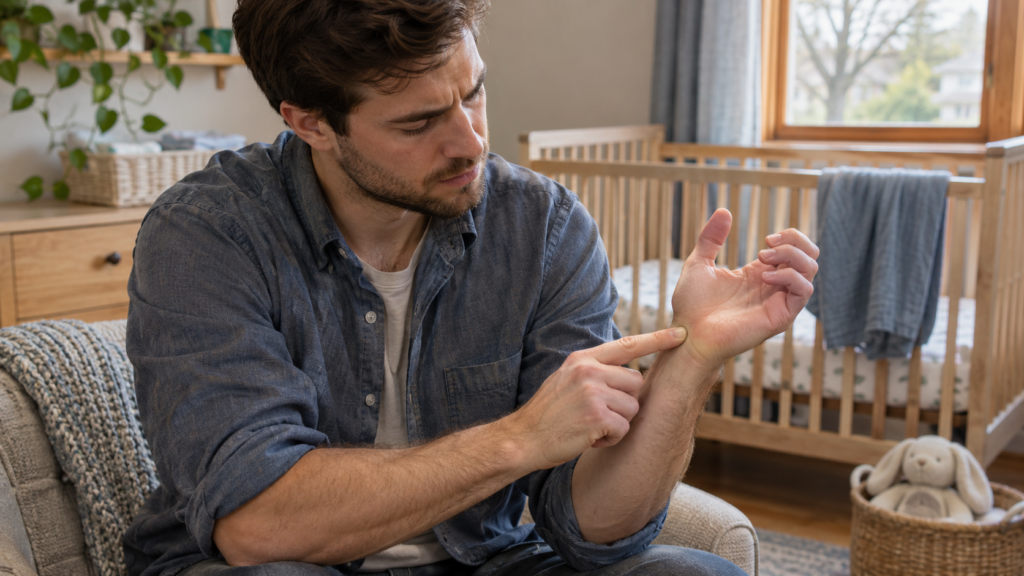
You reach into the crib to pick up your baby and feel a sharp pain on the thumb side of your wrist. Later, the same spot hurts when you turn a key or lift a coffee mug. You try resting it, but it’s hard to give your wrist a break when the movements that hurt are things you do dozens of times a day.
That pattern is common with de Quervain’s tenosynovitis, sometimes called mommy’s thumb. A physician may discuss a cortisone injection when an exam confirms de Quervain’s and the pain interferes with daily activities, or when a thumb brace and changes to your routine haven’t helped enough. An injection can be part of the initial treatment plan. You don’t have to spend weeks pushing through pain before asking whether it’s an option.
The decision depends on what the exam shows, how your symptoms are changing, and what you need your hand to do. Here’s how to think through those factors.
What does de Quervain’s tenosynovitis feel like?
The most useful clue is often where you feel the pain. With de Quervain’s, you can usually point to a tender spot near the bony bump on the thumb side of your wrist. Two tendons pass through a narrow tunnel there as they help move your thumb. When the tissue around them thickens or swells, the tendons have less room to glide comfortably.
You might barely notice it when your hand is resting on a table, then feel a sharp, localized pain when you pick something up. Common examples include:
- Lifting a baby under the arms with your thumbs spread wide
- Picking up a skillet or pouring from a full coffee pot with one hand
- Opening a tight jar or turning a stubborn doorknob
- Gripping and twisting a tool repeatedly at work
Some people also notice swelling over the tender spot or an ache that travels a short distance up the forearm. Despite the nickname, anyone can develop de Quervain’s. The movement that brings on the pain tells your physician more than the label “mommy’s thumb” or “wrist tendonitis” alone.
How does a physician confirm what’s causing the pain?
Pain near the base of the thumb can come from several places. Thumb joint arthritis, for example, can also make opening a jar painful. And if the pain began when you caught yourself during a fall, that detail changes what your physician needs to check.
During a sports medicine evaluation at Thrive Medicine, Dr. Jasbir Singh asks when the pain started, where you feel it, and which activities have become difficult. He can check for tenderness along the thumb tendons and gently move your thumb and wrist to see whether that reproduces the pain you recognize.
De Quervain’s can often be diagnosed from your history and a physical exam. If the tenderness is somewhere unexpected or the symptoms followed an injury, your physician may recommend imaging to look for another cause. That distinction matters because an injection for de Quervain’s targets a specific tendon sheath.
What can you try before a cortisone injection?
If symptoms are mild or already improving, de Quervain’s tenosynovitis treatment may start with a thumb spica brace and adjustments to the activities that aggravate your wrist. A thumb spica supports both your wrist and your thumb. If you’ve tried a wrist wrap that leaves your thumb free and concluded that bracing doesn’t work, bring it to your visit. The type of support you used is worth discussing.
It also helps to get specific about what “rest” could realistically mean. If you’re caring for a baby, you still have to lift your child. You can ask your clinician to watch how you lift and show you an adjustment that puts less strain on the painful area. If dinner prep sets it off, try supporting a heavy pan with both hands for now. If a particular tool bothers you at work, describe how you grip it and how often you use it. A small change to something you do throughout the day may be more practical than a general instruction to use your hand less.
Depending on your symptoms and health history, your physician may also discuss an anti-inflammatory medication or hand therapy. One way to judge progress is to pay attention to a familiar task. Is it getting easier to buckle the car seat or pour your morning coffee, or are you still reaching with your other hand every time?
When is a cortisone injection worth considering?
A cortisone injection is worth discussing when the diagnosis is clear and the pain is limiting something important to you. For one person, that might mean being unable to lift their child comfortably. For another, it might mean having to stop partway through a shift because every turn of a tool brings the pain back.
How your wrist feels over time matters, too. If the brace is helping and you can do more each week, you may prefer to keep going with that approach. If the pain returns as soon as you resume an essential activity, it’s reasonable to revisit the plan. And if your hand use is significantly limited from the start, your physician may discuss an injection at the first appointment.
Bracing and injections can also be used together. Research on de Quervain’s treatment supports discussing a corticosteroid injection followed by a short period in a thumb spica splint, often around three to four weeks. Your physician can help you weigh the expected benefit against the practical demands of your job or caregiving routine.
Where does a de Quervain’s injection go?
The target is the tendon sheath on the thumb side of the wrist. This sheath forms the tunnel around the two tendons that move your thumb. The physician places the medication into the space surrounding the tendons to reduce local swelling and irritation. The tendon fibers and the thumb joint are separate structures from the intended injection site. In some cases, a physician may use ultrasound to see the sheath and guide placement.
Before you decide, ask what benefit you can reasonably expect, how long to wear a brace afterward, and when to resume the activity that has been giving you trouble. Your medical history belongs in that conversation. For example, cortisone can temporarily raise blood sugar in people with diabetes. Skin thinning or changes in skin color can also occur near the injection site.
What if the pain comes back?
If an injection helps but the pain returns, notice which activity brings it back and whether it’s in the same spot. Being comfortable at rest but still unable to lift your child is worth mentioning at follow-up. So is pain that now feels deeper at the base of the thumb. Those details help your physician reassess the diagnosis, review how much the first treatment helped, and discuss whether to adjust your brace, consider hand therapy, or explore another option.
Get help for thumb-side wrist pain in Northville, MI
You don’t need to decide whether you want a cortisone shot before making an appointment. If thumb-side wrist pain keeps changing how you pick up your child, work with your hands, or get through ordinary tasks, the first step is finding out what’s causing it.
At Thrive Medicine in Northville, Jasbir Singh, DO, evaluates hand and wrist pain and helps patients choose a treatment plan that fits their daily lives. You can request an appointment with Thrive Medicine or call 248-880-3319. If you already wear a brace, bring it along and show Dr. Singh the movement you most want to get back to comfortably.
Medical Disclaimer: The information provided in this article is for general educational and informational purposes only and is not intended as, and should not be considered, medical advice, diagnosis, or treatment. Reading this content does not establish a patient-provider relationship with Thrive Medicine or any of its healthcare professionals. Always consult a qualified healthcare provider regarding your individual health, symptoms, medical conditions, or treatment options. Do not disregard or delay seeking professional medical advice because of information you have read on this website. If you believe you are experiencing a medical emergency, seek immediate medical attention or call 911. Individual results and treatment recommendations may vary.
