
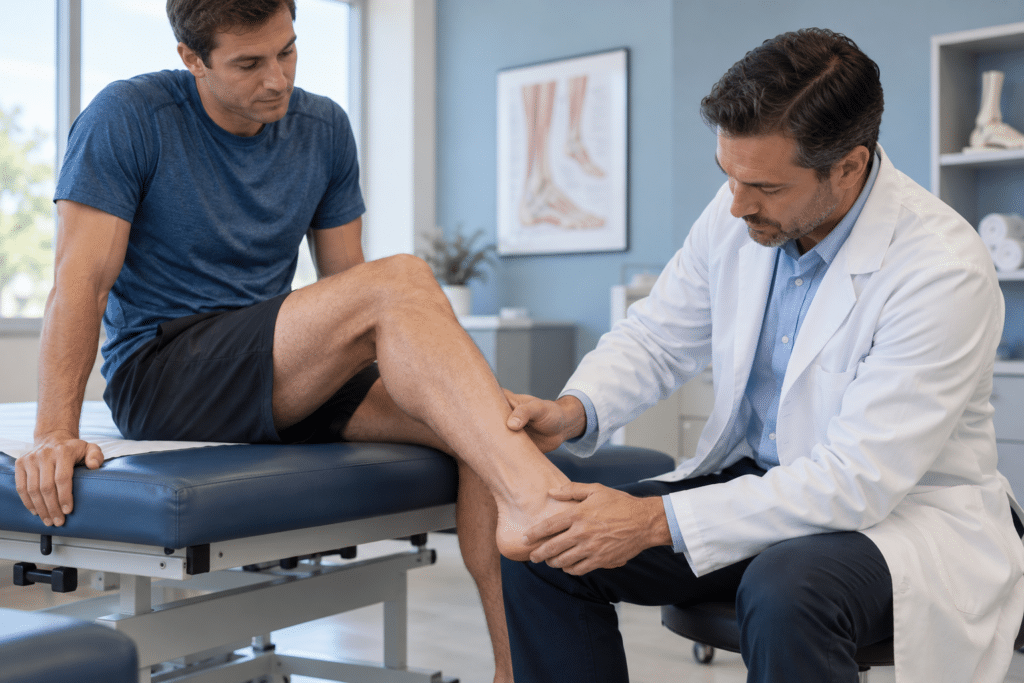
Achilles pain can start as a small inconvenience: stiffness during your first steps in the morning, soreness after a run, or discomfort when climbing stairs. When it keeps returning, it can become difficult to know whether you should keep exercising, take more time off, or try something different.
If Achilles tendon pain is persistent, worsening, or limiting your activities, a sports medicine evaluation can help identify the likely pain source and guide treatment, activity changes, and rehabilitation. You do not need to know exactly what is wrong before scheduling an appointment.
At Thrive Medicine in Northville, Michigan, sports medicine assessments provide an opportunity to discuss your symptoms, examine the affected area, and develop a personalized plan. Whether your goal is returning to running, playing recreational sports, or walking more comfortably, an evaluation can help clarify your next steps.
When Should You Get Achilles Tendon Pain Evaluated?
Consider scheduling an evaluation when pain keeps coming back, your symptoms are getting worse, or your ankle is interfering with everyday movement. An assessment can also be helpful when you have already tried changing your activities but do not know how to move forward.
Signs that it may be time for a sports medicine assessment include:
- Pain that returns whenever you resume running, exercise, or sports.
- Recurring stiffness during your first steps in the morning or after sitting.
- Discomfort that causes you to limp or change the way you walk.
- Pain that limits stairs, longer walks, or time spent on your feet.
- Symptoms that persist despite rest or changes to your routine.
- Uncertainty about whether the pain is coming from the Achilles tendon.
You do not have to wait until the pain becomes severe. If you are repeatedly stopping and restarting activities because of symptoms, an evaluation can help you make more informed decisions.
What Causes Achilles Tendon Pain?
The Achilles tendon connects your calf muscles to your heel bone. It helps you push off the ground when walking, running, climbing stairs, and jumping.
Pain in this area is commonly called Achilles tendonitis. A clinician may use the term Achilles tendinopathy, particularly when describing a persistent tendon problem involving pain and changes in function.
Symptoms can develop after increases in running distance, speed, hills, jumping, or workout frequency. They may also appear after returning to exercise following a period of reduced activity. Sometimes there is no single memorable event—the discomfort gradually becomes more noticeable.
The location of the pain matters:
- Midportion Achilles tendinopathy affects the tendon above its attachment to the heel bone.
- Insertional Achilles tendinopathy affects the area where the tendon attaches to the heel.
These patterns can influence rehabilitation decisions, including which movements are appropriate and how exercises are progressed. Pain around the back of the ankle can also involve nearby structures, so an examination is useful before assuming every symptom is Achilles tendonitis.
Why Does Achilles Pain Keep Coming Back?
A common frustration is feeling better after taking time off, only to have the same pain return when you resume your usual activities.
Reducing activity may settle symptoms without fully preparing the tendon and calf muscles for the demands of running, jumping, or prolonged walking. Returning to the same workload too quickly can then aggravate the problem again.
Other possibilities include exercises that need to be adjusted, activity demands that remain too high, or a pain source that has not been correctly identified. Persistent symptoms are a reason to review the plan rather than repeatedly trying the same approach.
An evaluation can help connect your symptoms with your activity history, examination findings, and goals.
What Happens During a Sports Medicine Evaluation?
An Achilles tendinopathy evaluation generally starts with a conversation about your symptoms, followed by a focused physical examination. Imaging may be considered when it would help answer a specific clinical question.
At Thrive Medicine, sports medicine assessments are performed by Dr. Jasbir Singh, DO. The visit includes a detailed history, a targeted examination, and treatment planning based on the findings.
Reviewing Your Symptoms and Activities
Your clinician may ask:
- When did the pain begin?
- Did it start suddenly or develop gradually?
- Where do you feel the discomfort?
- Which activities make it worse?
- Does it improve during activity and return afterward?
- What changes have you made to exercise, work, or daily movement?
- What treatments or exercises have you already tried?
Your goals also matter. Preparing for a race, returning to a recreational sport, and walking comfortably at work place different demands on the ankle. A useful plan takes those demands into account.
Examining Strength, Movement, and Function
A focused examination may assess tenderness, swelling, ankle movement, calf strength, and how symptoms respond to appropriate functional tasks.
The clinician may also look at surrounding areas when needed. The purpose is to identify the likely pain source and determine whether additional evaluation is necessary.
Deciding Whether Imaging Would Help
You do not automatically need an MRI before scheduling an appointment.
Many tendon problems can be assessed through the symptom history and physical examination. Imaging may be useful when the diagnosis is uncertain, a tear or another condition is suspected, or symptoms are not progressing as expected.
If you already have X-rays, an MRI, or an ultrasound, bring the reports and images if possible. Thrive Medicine reviews imaging when available or indicated and can advise whether further imaging or referral may be appropriate.
What Can Achilles Tendon Pain Treatment Include?
Achilles tendon pain treatment depends on the likely diagnosis, symptom severity, activity demands, and your individual goals. A personalized plan may combine activity adjustments, progressive rehabilitation, and other treatments when appropriate.
Adjusting Activities That Aggravate Symptoms
Activity changes may involve temporarily reducing running volume, modifying hills or speed work, or changing activities that repeatedly cause flare-ups.
The appropriate adjustment depends on your symptoms and evaluation. Some people can maintain suitable exercise while changing the activities that place the greatest demand on the tendon.
A clinician can help you understand what to modify, what to monitor, and when to reassess.
Building Strength Through Progressive Rehabilitation
For many people with Achilles tendinopathy, rehabilitation is a central part of treatment. Progressive tendon-loading exercises help build the strength and capacity needed for daily movement and more demanding activities.
A rehabilitation plan may involve calf strengthening and a gradual progression toward walking, running, jumping, or sport-specific demands. The starting point and pace should fit your current ability and symptom response.
Exercise recommendations may also differ depending on whether pain affects the middle of the tendon or its attachment to the heel. That is one reason a generic exercise routine may need to be adapted.
A sports medicine assessment can help establish rehabilitation priorities and determine whether working with a physical therapist would be appropriate.
Considering Additional Options When Appropriate
Some patients may need additional treatment or a referral based on their diagnosis and response to care.
Thrive Medicine offers a range of nonsurgical sports medicine services. If an injection is being considered, the discussion should address why it may be appropriate, its potential benefits and risks, the limits of the evidence, and how it fits into the overall plan.
PRP sports injections may be discussed in selected cases. PRP is not automatically recommended for persistent Achilles pain, and improvement is not guaranteed. Rehabilitation and appropriate activity progression remain important parts of treatment planning.
How Can You Tell Whether Rehabilitation Is Helping?
Progress may involve more than the pain level during one workout. Your clinician or physical therapist may consider changes in morning stiffness, walking comfort, strength, activity tolerance, and how symptoms respond later that day or the following morning.
Recovery can be gradual, and the plan may need adjustments along the way. If symptoms are worsening or you are not making expected progress, follow-up allows the diagnosis, exercise progression, and treatment options to be reviewed.
Rather than judging recovery against someone else’s timeline, focus on the milestones established for your situation.
When Does Achilles Pain Need Urgent Medical Attention?
A sudden injury requires different attention from pain that has developed gradually.
Seek urgent medical evaluation if you experience:
- A sudden snap or pop in the back of the ankle or calf.
- The feeling that someone kicked or struck the back of your leg.
- Sudden difficulty walking or pushing off the affected foot.
- Inability to rise onto your toes after an injury.
These symptoms can indicate an Achilles tendon rupture. Being able to take a few steps does not necessarily rule out a significant injury.
Sports Medicine Assessment for Achilles Pain in Northville
Persistent Achilles pain can affect much more than exercise. It can change how you walk, limit your workday, and make you hesitant to return to activities you enjoy.
At Thrive Medicine, an evaluation provides an opportunity to understand the likely cause and discuss a plan suited to your needs. The assessment considers your symptoms, movement, activity history, and goals, with guidance on rehabilitation strategies, treatment options, imaging, or referral when appropriate.
If you live in Northville, Novi, Plymouth, or a nearby community and need help understanding persistent ankle tendon pain, learn more about sports medicine assessments at Thrive Medicine.
Frequently Asked Questions About Achilles Tendon Pain
Should I see a sports medicine doctor for Achilles tendon pain?
A sports medicine evaluation can be helpful when Achilles pain persists, keeps returning, changes how you walk, or limits exercise and daily activities. It can also help when you are unsure of the diagnosis or what treatment to try next.
Can I keep running with Achilles tendon pain?
That depends on your symptoms and the likely diagnosis. Your clinician may recommend reducing or temporarily changing running while you work on rehabilitation. Seek urgent evaluation after a sudden injury involving a pop, major weakness, or difficulty pushing off.
Do I need an MRI before my appointment?
Not necessarily. The clinician can evaluate your symptoms and examination findings first, then determine whether imaging would be useful. Bring any existing imaging reports or images to your appointment.
Is stretching enough to treat Achilles tendon pain?
Stretching alone may not address the strength and activity demands involved in Achilles tendinopathy. Some people need a progressive strengthening plan, and certain movements may require modification based on where the tendon hurts.
Does persistent Achilles pain mean I need surgery?
Persistent pain does not automatically mean surgery is necessary. An evaluation can help identify appropriate nonsurgical options and determine when a specialist referral may be needed.
Is sports medicine only for competitive athletes?
No. Sports medicine assessments can help active adults, recreational athletes, and people whose tendon or joint pain affects everyday movement.
Schedule Your Sports Medicine Assessment
You do not need to know exactly what is causing your Achilles pain before seeking help. An assessment is a place to discuss the problem, understand the likely source, and decide on practical next steps.
To request a sports medicine assessment in Northville, contact Thrive Medicine or call 248-880-3319.
Medical Disclaimer: The information provided in this article is for general educational and informational purposes only and is not intended as, and should not be considered, medical advice, diagnosis, or treatment. Reading this content does not establish a patient-provider relationship with Thrive Medicine or any of its healthcare professionals. Always consult a qualified healthcare provider regarding your individual health, symptoms, medical conditions, or treatment options. Do not disregard or delay seeking professional medical advice because of information you have read on this website. If you believe you are experiencing a medical emergency, seek immediate medical attention or call 911. Individual results and treatment recommendations may vary.
