
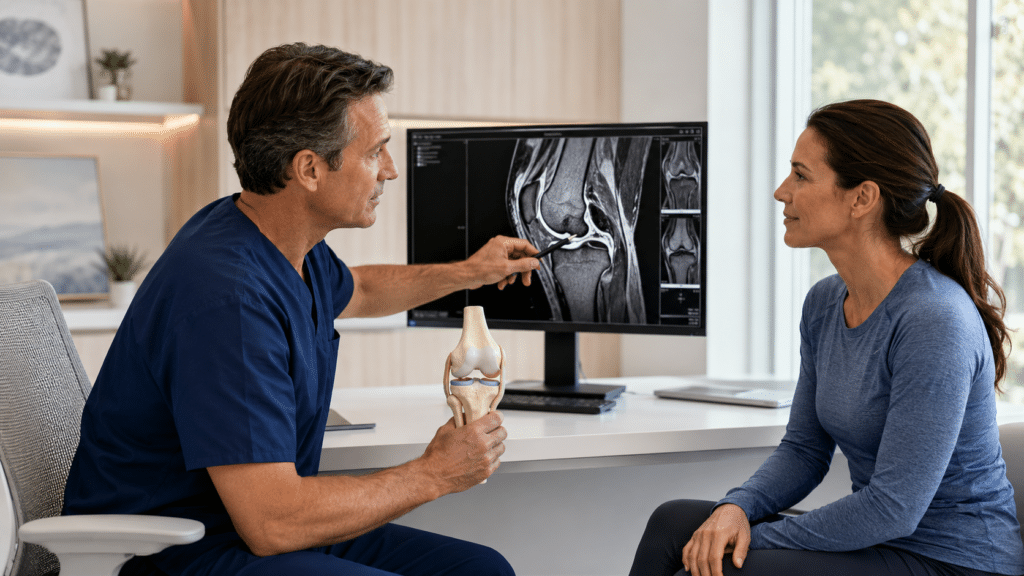
A meniscus injury can make the knee feel painful, swollen, unstable, or difficult to move. Some people notice symptoms after a sudden twist during sports, while others develop knee pain gradually without a single memorable injury.
When a meniscus tear is diagnosed, one of the first questions patients often ask is whether surgery can be avoided.
Many meniscus injuries can initially be managed without surgery. Depending on the type, location, and stability of the tear, treatment may include activity modification, rehabilitation, strengthening, and other forms of conservative care.
For selected patients, PRP for a meniscus tear may also be considered. Platelet-rich plasma is intended to support the body’s natural healing response and may help improve pain and knee function. However, PRP cannot mechanically reposition a displaced tear, repair every type of meniscus damage, or guarantee that surgery will never be necessary.
The first step is understanding what kind of meniscus injury you have.
What Is the Meniscus?
The menisci are two C-shaped pieces of fibrocartilage located between the thigh bone and shin bone in each knee.
The medial meniscus is located on the inside of the knee, while the lateral meniscus is located on the outside. Together, they help:
- Absorb shock
- Distribute weight across the knee
- Improve joint stability
- Protect the articular cartilage
- Support smooth knee movement
Because the meniscus plays an important role in protecting the joint, modern treatment often focuses on preserving as much healthy meniscal tissue as possible.
How Do Meniscus Injuries Happen?
A meniscus can be injured during a sudden twisting or pivoting movement, especially when the foot is planted and the knee is bent.
Acute meniscus injuries are common in sports that involve:
- Cutting and changing direction
- Pivoting
- Squatting
- Jumping and landing
- Direct contact
- Rapid acceleration or deceleration
Meniscus problems can also develop gradually. As the tissue changes with age, it may become less resilient and more vulnerable to tearing during normal activities.
This creates two broad categories:
Acute Meniscus Tears
Acute tears usually occur during a specific injury. A person may feel a pop or immediate pain after twisting the knee.
Degenerative Meniscus Tears
Degenerative tears develop as the meniscus changes over time. Symptoms may appear gradually or begin after a relatively minor movement.
The distinction matters because an acute displaced tear in a younger athlete may require a different treatment approach than a degenerative tear found in a middle-aged or older adult.
What Are the Symptoms of a Meniscus Injury?
Meniscus symptoms vary based on the location, size, pattern, and stability of the injury.
Common symptoms include:
- Pain along the inside or outside of the knee
- Swelling
- Stiffness
- Difficulty fully bending or straightening the knee
- Clicking, catching, or popping
- Pain during squatting or twisting
- A feeling that the knee may give way
- Reduced ability to run, jump, or change direction
Some meniscus tears cause few symptoms and are discovered incidentally on imaging. That is why treatment should be based on the complete clinical picture rather than an MRI finding alone.
Can a Meniscus Tear Heal on Its Own?
Some meniscus tears have a better chance of healing than others.
The outer portion of the meniscus receives a better blood supply and is sometimes called the red zone. Tears in this area may have more healing potential.
The inner portion has a limited blood supply and is often called the white zone. Tears located entirely within this area generally have less natural healing potential.
Other important factors include:
- Tear location
- Tear pattern
- Tear size
- Whether the tissue is displaced
- Age of the injury
- Patient age and health
- Knee stability
- The presence of arthritis
- Additional ligament or cartilage damage
A small, stable tear may improve with conservative care. A displaced tear that blocks normal knee movement is less likely to respond to an injection or rehabilitation alone.
Does Every Meniscus Tear Require Surgery?
No. Many meniscus injuries can initially be treated without surgery.
A non-surgical meniscus treatment plan may include:
- Temporary activity modification
- Ice for short-term swelling
- Bracing when appropriate
- Physical therapy
- Improving knee range of motion
- Quadriceps and hamstring strengthening
- Hip and glute strengthening
- Gradual return to activity
- Medication when medically appropriate
- Injection-based treatment in selected cases
Surgery may be considered when the knee remains significantly painful despite appropriate care, the tear is displaced, the knee is mechanically locked, or the injury is likely to benefit from repair.
The American Academy of Orthopaedic Surgeons’ clinical guideline notes that displaced acute tears restricting knee motion may benefit from early surgical intervention. The guideline also recognizes a role for rehabilitation in non-operative treatment.
What Is PRP?
Platelet-rich plasma, or PRP, is prepared from a sample of the patient’s own blood.
The blood is processed in a centrifuge to separate and concentrate the platelets. Platelets contain growth factors and signaling proteins involved in the body’s natural healing response.
The platelet-rich portion is then injected into the targeted area.
A PRP knee injection is not a steroid, synthetic medication, or surgical implant. The goal is to create a biological environment that may support tissue recovery and improve symptoms.
How Could PRP Help a Meniscus Injury?
The meniscus has a limited blood supply, particularly in its inner portion. This can make healing difficult.
PRP delivers concentrated platelets and their growth factors to the treatment area. These substances may help support biological processes involved in tissue repair and regulate the inflammatory environment within the knee.
For a meniscus injury, PRP may potentially:
- Reduce pain
- Improve knee function
- Support the body’s healing response
- Help a patient participate more comfortably in rehabilitation
- Improve symptoms associated with a degenerative meniscus tear
- Delay or avoid surgery in selected cases
PRP should not be expected to stitch torn tissue back together or reposition a displaced fragment. Its role is biological rather than mechanical.
Is PRP Effective for Meniscus Tears?
The research on PRP for non-surgical meniscus treatment is promising but still limited.
A systematic review of PRP for nonoperative management of degenerative meniscus tears found that many included studies reported improvements in pain and function. However, the studies varied considerably in their PRP preparation, injection technique, treatment schedule, imaging outcomes, and patient selection.
This means PRP may provide meaningful symptom relief for some patients, but the current evidence does not establish that it consistently heals every meniscus tear.
Research is more established for PRP used during certain meniscus repair surgeries than it is for PRP as a standalone treatment. AAOS guidance states that PRP may be considered as a biological enhancement during surgical repair of selected acute isolated tears, although the strength of that recommendation remains limited.
The most accurate conclusion is that PRP may be an option for carefully selected patients, but results cannot be guaranteed.
Who May Be a Good Candidate for PRP?
A patient may be considered for PRP when they have:
- A stable meniscus injury
- A degenerative meniscus tear
- Persistent pain despite appropriate conservative care
- Symptoms that limit exercise or daily activities
- No true mechanical locking
- A desire to explore non-surgical options
- Realistic expectations about the potential results
PRP may also be considered when symptoms are influenced by early arthritis or inflammation within the knee, although the treatment plan should address all contributing conditions.
A physician-led sports medicine assessment can help determine whether the meniscus is likely to be the main source of pain.
When Is PRP Less Likely to Help?
PRP is less likely to be an appropriate standalone treatment when:
- A displaced tear blocks knee movement
- The knee is truly locked
- A large fragment is mechanically unstable
- There is a meniscal root tear
- The injury occurs with a major ligament tear
- The knee has severe instability
- Advanced arthritis is the primary cause of symptoms
- The tear is likely to benefit from surgical repair
- The diagnosis is uncertain
In these situations, delaying an appropriate surgical evaluation could make treatment more difficult or reduce the opportunity to preserve meniscal tissue.
What Is the Difference Between Painful Catching and a Locked Knee?
People often use the word “locking” to describe several different sensations.
Painful catching may occur when the knee briefly hesitates, clicks, or feels uncomfortable during movement. A truly locked knee cannot fully bend or straighten because something is mechanically blocking motion.
A true locked knee requires prompt medical evaluation. It may indicate a displaced meniscus tear or another mechanical problem that is unlikely to be corrected by an injection.
How Is a Meniscus Injury Diagnosed?
Diagnosis begins with a medical history and physical examination.
Your physician may ask:
- How the injury occurred
- Where the knee hurts
- Whether swelling developed
- Which movements aggravate symptoms
- Whether the knee catches or locks
- Whether the knee feels unstable
- Which treatments have already been attempted
The examination may include joint-line tenderness, range-of-motion testing, and maneuvers that place controlled stress on the meniscus.
An MRI may be recommended when imaging is likely to clarify the diagnosis or change treatment. However, imaging findings should be interpreted alongside the patient’s symptoms and examination.
What Happens During a PRP Knee Injection?
If PRP is considered appropriate, the process generally involves:
- Drawing a small sample of blood from the patient.
- Processing the blood in a centrifuge.
- Concentrating the platelets into a PRP preparation.
- Cleaning and preparing the knee.
- Injecting the PRP into the targeted area.
- Providing individualized recovery instructions.
The complete appointment takes longer than the injection itself because the blood must be processed.
You can learn more about the procedure on Thrive Medicine’s PRP sports injections page.
What Is Recovery Like After PRP?
Temporary soreness, stiffness, or swelling may occur after a PRP knee injection. This reaction can last for several days.
Patients may be advised to temporarily avoid strenuous activity, deep squatting, pivoting, running, or high-impact exercise. Recommendations depend on the condition and injection performed.
PRP generally does not provide immediate relief. Improvement may develop gradually over several weeks or months.
A recovery plan may include:
- Temporary activity modification
- Gradual return to weight-bearing exercise
- Restoring knee range of motion
- Quadriceps and hamstring strengthening
- Hip and glute strengthening
- Balance and stability work
- Progressive return to running or sports
PRP should complement appropriate rehabilitation rather than replace it.
How Long Does PRP Take to Work?
There is no exact timeline that applies to every patient.
Some people begin noticing improvement within several weeks. Others may require several months before deciding whether treatment provided meaningful benefit.
The response may depend on:
- Tear type and location
- Severity of symptoms
- Duration of the injury
- The presence of arthritis
- PRP preparation and injection technique
- Activity level
- Rehabilitation
- Individual healing response
Because improvement is gradual, patients should not judge the final result based only on how the knee feels during the first few days.
How Many PRP Injections Are Needed?
Some treatment plans involve one PRP injection, while others use a series.
The number of injections depends on the condition, treatment protocol, and patient response. More injections do not automatically produce better results.
A physician should explain the recommended plan, expected timeline, cost, and alternatives before treatment begins.
PRP vs. Steroid Injections for a Meniscus Injury
PRP and steroid injections have different goals.
A corticosteroid injection may reduce inflammation and provide temporary symptom relief, particularly when arthritis or joint inflammation contributes to the pain. It does not repair the meniscus.
PRP is intended to support a biological healing response. Improvement is generally more gradual, and evidence for nonoperative meniscus healing remains limited.
For a broader comparison, read PRP vs. Prolotherapy vs. Steroid Injections.
Can PRP Help You Avoid Meniscus Surgery?
PRP may help selected patients manage their symptoms and continue functioning without surgery. However, it cannot guarantee that surgery will be avoided.
A patient may reasonably continue with non-surgical care when:
- The tear is stable
- Symptoms are improving
- The knee is not locked
- Daily activity is manageable
- Strength and motion are returning
- The patient understands the limitations of treatment
Surgical evaluation may still be appropriate when symptoms remain severe, mechanical problems continue, or the tear has characteristics that make repair more likely to succeed.
The goal should not be to avoid surgery at all costs. The goal is to choose the treatment that best preserves knee function and supports long-term joint health.
Frequently Asked Questions About PRP for Meniscus Tears
Can PRP completely heal a torn meniscus?
PRP cannot guarantee complete healing. Its effectiveness depends on the type, location, stability, and severity of the tear. Some patients may experience improved pain and function without complete healing on imaging.
Can a meniscus tear heal without surgery?
Some small, stable tears may heal or become asymptomatic with conservative care. Other tears have limited healing potential because of poor blood supply or mechanical instability.
Does PRP work for degenerative meniscus tears?
Early research suggests PRP may improve pain and function for some patients with degenerative tears, but study quality and treatment protocols vary. More research is needed.
Is a PRP knee injection painful?
Patients may feel pressure or brief discomfort during the injection. Temporary soreness or swelling can occur afterward.
Can I walk after PRP?
Many patients can walk after a PRP knee injection, although activity may need to be reduced temporarily. Follow the specific instructions provided by your physician.
How do I know if my meniscus tear needs surgery?
Displaced tears, a truly locked knee, significant motion restriction, or symptoms that do not improve with appropriate conservative care may require surgical evaluation.
Does insurance cover PRP for meniscus injuries?
Many insurance plans do not cover PRP for musculoskeletal conditions. Patients should confirm coverage and costs before treatment. Thrive Medicine operates as a self-pay clinic, and HSA or FSA funds may be accepted for eligible sports medicine services.
PRP for Meniscus Injuries in Northville, MI
If a meniscus injury is limiting your mobility, exercise, work, or daily activities, the first step is determining what type of injury you have.
At Thrive Medicine in Northville, Michigan, Dr. Jasbir Singh provides physician-led sports medicine assessments and personalized non-surgical treatment options for patients from Northville, Novi, Plymouth, and surrounding communities.
We will evaluate your symptoms, discuss whether imaging or referral is appropriate, and explain whether PRP or another treatment may fit your condition and goals.
Call 248-880-3319 or contact Thrive Medicine to schedule a sports medicine consultation.
Medical Disclaimer: The information provided in this article is for general educational and informational purposes only and is not intended as, and should not be considered, medical advice, diagnosis, or treatment. Reading this content does not establish a patient-provider relationship with Thrive Medicine or any of its healthcare professionals. Always consult a qualified healthcare provider regarding your individual health, symptoms, medical conditions, or treatment options. Do not disregard or delay seeking professional medical advice because of information you have read on this website. If you believe you are experiencing a medical emergency, seek immediate medical attention or call 911. Individual results and treatment recommendations may vary.
