
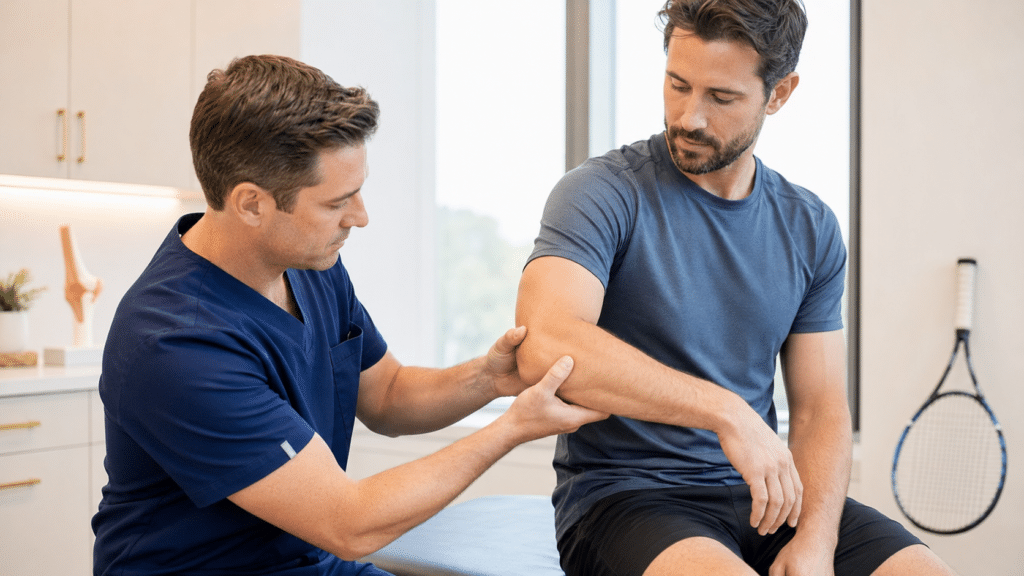
Tennis elbow can make everyday movements surprisingly difficult. Lifting a coffee mug, gripping a tool, typing, exercising, or turning a doorknob may all cause pain along the outside of the elbow.
When rest, activity changes, and rehabilitation do not provide enough relief, many patients begin exploring platelet-rich plasma therapy. But is PRP for tennis elbow actually effective?
The short answer is that PRP may help some patients with persistent tennis elbow, particularly when the condition has not improved with appropriate conservative care. However, results vary, research remains mixed, and PRP is not automatically the right treatment for every case of elbow pain.
A proper diagnosis is the first step in determining whether a PRP injection may be appropriate.
What Is Tennis Elbow?
Tennis elbow, medically known as lateral epicondylitis or lateral elbow tendinopathy, affects the tendons that attach the forearm muscles to the outside of the elbow.
Despite its name, you do not need to play tennis to develop it. The condition is often associated with repetitive gripping, lifting, twisting, or wrist-extension movements. It can affect athletes, tradespeople, office workers, musicians, weightlifters, and anyone whose activities repeatedly stress the forearm tendons.
Common symptoms include:
- Pain or tenderness along the outside of the elbow
- Pain that travels into the forearm
- Discomfort when gripping or lifting objects
- Pain with wrist or forearm movements
- Reduced grip strength
- Symptoms that worsen during work, exercise, or recreational activities
Tennis elbow is frequently described as an inflammatory condition, but persistent cases often involve degenerative changes and disorganization within the affected tendon. This distinction helps explain why simply reducing inflammation may not resolve every case.
What Is PRP Therapy?
Platelet-rich plasma, or PRP, is prepared from a sample of the patient’s own blood.
During treatment, blood is drawn and placed into a centrifuge, which separates and concentrates the platelets. The resulting platelet-rich plasma is then injected into the targeted area.
Platelets contain growth factors and signaling proteins involved in the body’s natural healing response. When PRP is injected into an injured tendon, the goal is to create an environment that may support tissue repair and gradual improvement.
Unlike a steroid injection, which is primarily used to reduce inflammation and provide symptom relief, PRP is intended to support the healing process within the affected tissue.
How Does PRP for Tennis Elbow Work?
A PRP injection for elbow pain is generally directed into or around the damaged portion of the common extensor tendon near the outside of the elbow.
The treatment is not intended to instantly numb the area or provide immediate pain relief. In fact, some patients experience temporary soreness after the injection. Any improvement typically develops gradually as the tendon responds over the following weeks and months.
PRP may potentially help by:
- Delivering concentrated platelets to the injured tendon
- Supporting the body’s repair response
- Encouraging gradual tendon healing
- Reducing pain over time
- Improving grip strength and elbow function
Because tennis elbow can have different causes and levels of severity, PRP should only be considered after confirming that the symptoms are actually coming from the affected tendon.
Is PRP Effective for Tennis Elbow?
Research on PRP for tennis elbow has produced mixed results.
Some studies comparing PRP with corticosteroid injections suggest that steroid injections may provide faster short-term relief, while PRP may offer better pain and functional outcomes over longer follow-up periods. However, other placebo-controlled studies have not found a meaningful advantage for PRP.
These differences may be related to several factors:
- How PRP is prepared
- Platelet concentration
- Injection technique
- Whether ultrasound guidance is used
- Duration and severity of the condition
- Treatments attempted before PRP
- Rehabilitation following the injection
- Differences between individual patients
The most accurate conclusion is that PRP is a promising option for certain patients with persistent tennis elbow, but it is not guaranteed to work. A physician should evaluate the injury, discuss the available evidence, and explain how PRP compares with other treatment options.
Who May Be a Good Candidate for PRP?
PRP may be considered when tennis elbow symptoms have continued despite an appropriate period of conservative treatment.
A potential candidate may have:
- Elbow pain lasting several weeks or months
- Symptoms consistent with lateral elbow tendinopathy
- Pain that limits work, exercise, or normal activities
- Limited improvement from activity modification or rehabilitation
- A desire to explore non-surgical treatment
- No medical condition that would make PRP inappropriate
PRP is not necessarily the first treatment recommended for a recent or mild case of tennis elbow. Many patients improve without an injection when the condition is identified early and properly managed.
When Might PRP Not Be Appropriate?
Not every case of elbow pain is tennis elbow. Similar symptoms may result from arthritis, nerve irritation, ligament injuries, referred pain from the neck, or other tendon conditions.
PRP may not be appropriate when:
- The diagnosis is unclear
- Symptoms are caused by a different elbow condition
- The tendon has a significant tear that requires another approach
- The patient has certain blood, platelet, or bleeding disorders
- There is an active infection
- Conservative treatment has not yet been attempted
- The patient expects immediate pain relief
A sports medicine assessment helps determine what structure is causing the pain and whether PRP is a reasonable option.
What Happens During a PRP Injection for Elbow Pain?
The process generally begins with a medical evaluation. The physician reviews the patient’s symptoms, activity history, prior treatments, and health history before examining the elbow.
If PRP is recommended, the treatment typically involves the following steps:
- A small sample of blood is drawn.
- The blood is processed in a centrifuge to concentrate the platelets.
- The outside of the elbow is cleaned and prepared.
- The PRP is injected into the targeted tendon.
- The patient receives instructions for activity and recovery.
The injection itself usually takes only a few minutes, although the complete appointment takes longer because the PRP must be prepared.
What Is Recovery Like After PRP?
Temporary soreness, stiffness, or discomfort around the injection site is common. This initial response does not necessarily indicate that something is wrong.
Patients may be instructed to limit strenuous gripping, lifting, or repetitive arm movements for a period after treatment. A gradual return to activity and an appropriate rehabilitation plan may be important parts of recovery.
PRP does not usually produce immediate improvement. Some patients notice changes within several weeks, while tendon healing and functional improvement may continue over several months.
Recovery varies based on:
- The severity and duration of the condition
- The patient’s occupation and activities
- Overall health
- Adherence to post-treatment instructions
- Rehabilitation and progressive tendon loading
- Individual response to treatment
PRP vs. Steroid Injections for Tennis Elbow
PRP and steroid injections have different goals.
A corticosteroid injection is intended to reduce inflammation and may provide relatively quick pain relief. However, that relief can be temporary, and repeated steroid injections may not be appropriate for a degenerative tendon condition.
PRP is intended to support a longer-term healing response. Improvement is generally slower and may require more patience during recovery.
Neither treatment is universally better for every patient. The choice depends on the diagnosis, duration of symptoms, previous care, short-term needs, and long-term goals.
What Other Tennis Elbow Treatments Are Available?
A personalized tennis elbow treatment plan may include:
- Temporary activity modification
- Changes to equipment, technique, or workplace ergonomics
- Bracing or a counterforce strap
- Physical therapy or guided exercises
- Progressive strengthening of the forearm tendons
- Medication when medically appropriate
- PRP therapy
- Other injection-based treatments
- Surgery in uncommon, persistent cases
Treatment should address more than pain alone. It should also consider the movements, training habits, occupational demands, or biomechanical factors that may be repeatedly stressing the tendon.
Can Tennis Elbow Heal Without an Injection?
Yes. Many cases improve with time and an appropriate conservative treatment plan.
Simply resting the elbow indefinitely, however, may not fully restore the tendon’s ability to tolerate activity. Gradual strengthening and correction of aggravating factors are often important for returning to normal use and reducing the likelihood of recurring symptoms.
PRP is generally considered when symptoms persist or when progress has stalled despite an appropriate initial treatment plan.
How Many PRP Treatments Are Needed?
The number of treatments depends on the patient, the PRP protocol, and the severity of the tendon condition. Some patients may receive one injection, while others may be advised to consider additional treatment based on their response.
More injections do not automatically produce better results. The decision should be based on symptoms, function, examination findings, and progress over time.
Is PRP for Tennis Elbow Worth Considering?
PRP may be worth considering if you have persistent, properly diagnosed tennis elbow that has not improved with conservative care.
The best candidates understand that:
- PRP is not guaranteed to work
- Results are usually gradual
- Temporary post-injection soreness is common
- Rehabilitation may still be necessary
- The effectiveness of PRP varies among patients
- Accurate diagnosis and injection technique matter
PRP should be viewed as one part of a comprehensive treatment plan rather than a quick fix.
Frequently Asked Questions About PRP for Tennis Elbow
How long does PRP take to work for tennis elbow?
Improvement is generally gradual. Some patients begin noticing changes within several weeks, while continued improvement may occur over several months. Results and recovery times vary.
Is a PRP injection for elbow pain painful?
Patients may feel pressure or discomfort during the injection, followed by temporary soreness afterward. Your physician can explain what to expect and how to manage post-treatment discomfort.
Can I return to work after PRP?
This depends on the physical demands of your job. Patients with desk-based work may return sooner than those whose jobs require repetitive gripping, heavy lifting, or forceful arm movements.
Is PRP better than a cortisone injection?
PRP and cortisone serve different purposes. Cortisone may provide faster short-term symptom relief, while PRP is intended to support a gradual healing response. Neither option is best for every patient.
Does PRP permanently cure tennis elbow?
No treatment can guarantee a permanent cure. Results depend on the condition of the tendon, the patient’s activities, rehabilitation, and whether the factors contributing to the injury are addressed.
Do you need imaging before PRP?
Not every patient needs imaging. A physician may recommend an ultrasound, X-ray, MRI, or another test when the diagnosis is uncertain or the results could change the treatment plan.
PRP Treatment for Tennis Elbow in Northville, MI
If elbow pain is interfering with work, exercise, or daily life, an accurate diagnosis is the first step.
At Thrive Medicine in Northville, Michigan, Dr. Jasbir Singh provides physician-led sports medicine assessments and personalized non-surgical treatment options for patients from Northville, Novi, Plymouth, and surrounding communities.
If PRP is appropriate for your condition, we will explain the procedure, expected recovery, potential benefits, limitations, and alternative treatments so you can make an informed decision.
Contact Thrive Medicine at 248-880-3319 to schedule a sports medicine consultation and learn whether PRP may be an appropriate option for your elbow pain.
Medical Disclaimer: The information provided in this article is for general educational and informational purposes only and is not intended as, and should not be considered, medical advice, diagnosis, or treatment. Reading this content does not establish a patient-provider relationship with Thrive Medicine or any of its healthcare professionals. Always consult a qualified healthcare provider regarding your individual health, symptoms, medical conditions, or treatment options. Do not disregard or delay seeking professional medical advice because of information you have read on this website. If you believe you are experiencing a medical emergency, seek immediate medical attention or call 911. Individual results and treatment recommendations may vary.
